


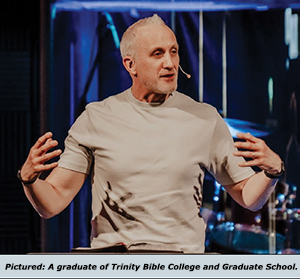
 “We are unapologetically a Bible college. We’ve built everything—our programs, our community, our entire identity—around spiritual formation and mission. We’re not trying to be a liberal arts university. We know who we are, and students find that authenticity deeply compelling,” says Dr. Paul R. Alexander, president of Trinity Bible College & Graduate School.
Rather than chasing trends or expanding into disciplines that dilute its core mission, Trinity has embraced a focused academic model centered on what it terms “compatible disciplines.” These include fields such as teacher education, entrepreneurial studies, and fitness science—areas that align with the Christian mission without overshadowing the centrality of biblical and theological training.
Even the admissions journey at Trinity is intentionally personal. Prospective students are invited to College Days held twice a year, and from there, enrollment counselors provide individualized guidance. The admissions process includes a statement of faith, pastoral references, and a commitment to a Community Life Statement—reflecting the school’s serious approach to maintaining a mission-focused culture.
Every undergraduate student at Trinity is required to complete over 30 credits in Bible and ministry studies. More than just coursework, the program demands real-world application: each student, regardless of major or year, must participate in a mission trip during the semester—a self-funded endeavor that underscores the school’s commitment to experiential learning and global engagement.
-
We’re not trying to be a liberal arts university. We know who we are, and students find that authenticity deeply compelling
Here’s what Nathaniel, one of the fellow students had to say about Trinity:
 “Trinity impacted my life by teaching me how to serve. I was given many opportunities to serve, to include an RA, a worship volunteer, and leading a campus prayer group. Service is a part of the culture at Trinity. Everyone, in some capacity, walks away with multiple hours of service and the character of doing so. Also, it's evident that the staff and faculty live out an attitude of service as well. I am currently using those attitudes and skills to serve my church as the Associate and Youth Pastor. I had the opportunity to meet my wife at TBC. Arianna agrees that service is in the culture of TBC. She stepped into a Kid's Pastor position right after graduation and served her heart out. Currently, she is taking a season to serve our family as we welcomed our first child in 2023. Trinity set our ministry career for success, but also, our family to serve.”
The school’s identity extends beyond the classroom. “Community” is a word that surfaces frequently when students speak about their experience at Trinity—and for good reason. The campus culture is intentionally built around accessibility, connection, and shared spiritual growth. Faculty and students regularly share meals, engage in chapel services held four times a week, and participate in campus-wide ministries and outreach events. The spiritual infrastructure is supported by a campus pastor and, uniquely, a Vice President of Experiential Learning—a position rarely found at institutions of Trinity’s size and focus.
 Financial accessibility remains a key pillar of Trinity’s commitment to its students. The college offers a transparent pricing model—publishing costs that reflect the actual expense of attendance and then applying generous scholarships. Each year, Trinity awards roughly $300,000 in donor-funded scholarships to returning students, in addition to significant institutional discounts. A robust federal work-study program supplements this model, paying students well above minimum wage and offering practical work experiences on and off campus. The result is a student body that graduates with low debt and a clear sense of purpose.
While Trinity’s undergraduate program continues to grow steadily, the graduate school has experienced exponential expansion. Now boasting nearly 300 students across five master’s programs, a Doctor of Contextual Leadership, and a Ph.D., Trinity’s graduate offerings are drawing students from around the globe. With learners from 48 nations currently enrolled, the school’s reach is increasingly international.
It is this deliberate cultivation of spiritual maturity alongside academic achievement that distinguishes Trinity from many of its peers. Every course is mission-aligned, intentionally designed to fulfill the institution’s guiding statement:
“To educate and train with theological reflection and missional passion so that students demonstrate the love of Jesus everywhere.”